Friday, February 8, 2019

Then & Now Art®: The Art Institute - Chicago, IL [1915/2018]


Then & Now Art®: The Art Institute - Chicago, IL

Years: 1915 & 2018 = 103 years in transition.  

This view is showcasing the iconic Art Institute of Chicago's historic lion statues.  The statue faces south, along Michigan Avenue, one of the locations located on the Magnificent Mile of Downtown Chicago.  

This image is very cool, because theres a lot of people walking amongst each other from both time periods on the sidewalk.  If you look close, you can actually see that they are using the same light poles, over a 100 years later.  I assume that they are actually new poles but they used the same style of pole as the old ones.  


To purchase this image, click here: 


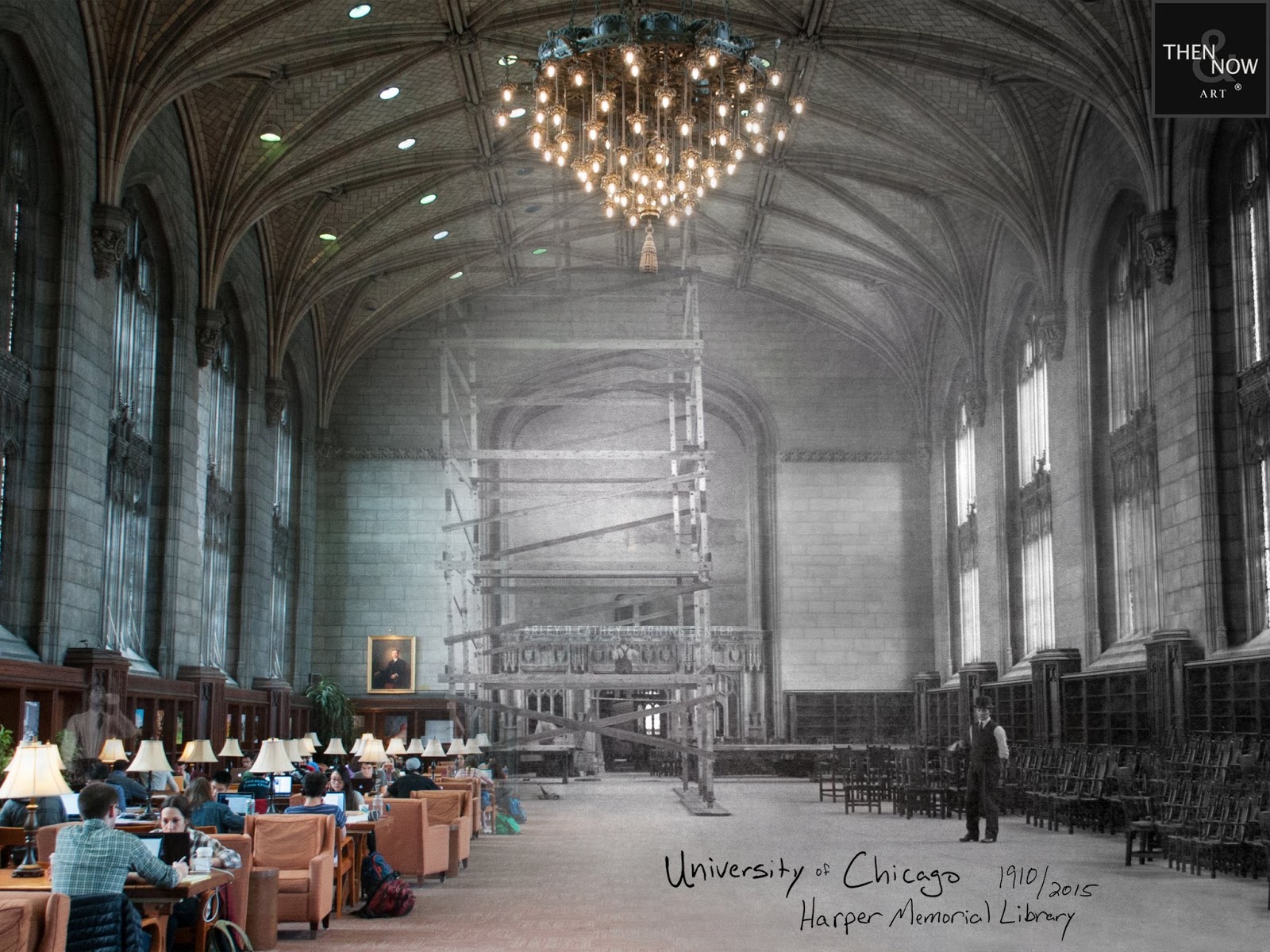
Then & Now Art®: Harper Memorial Library - University of Chicago [1910/2015]


Then & Now Art®: Harper Memorial Library - University of Chicago 

Years: 1910 & 2015 = 105 years in transition.


This image is very cool.  Its the only indoor Then & Now in our collection.  Thats because indoor photography was much more rare in the early 1900's - the reason for that is there is a lot less light indoors compared to outdoors, and with photography still in its infancy, lenses and films weren't capable of capturing light as quickly as we do it now.  Because of this, people had to hold very still when taking photos indoors. 

In this particular image you can actually see some people building the Library (now its mostly used as a study hall).  The man on the right is posing for the camera, you can also see a man working along the back wall on the scaffolding.  On the left, amongst the students from Now, you can actually see a worker taking a much needed break - drinking what looks like his milk for the photo.  


If you're looking for a way to purchase this image, go here:


Then & Now Art®: Hutchinson Courtyard - University of Chicago [1900/2017]


Then & Now Art®: Hutchinson Courtyard - University of Chicago

Years: 1900 & 2017 = 117 years in transition.

This image spans 117 years of center of The University of Chicago.  This image weaves in and out from then to now and now to then.  A few notes about this image: you can see a woman from 1900 walking along the left hand side, as well as another woman from 1900 walking through the center of the courtyard.  


Want to purchase this image?  You can find it here: 


Then & Now Art®: Water Tower - Chicago, IL [1950's/2016]


Then & Now Art®: Water Tower - Chicago, IL [1950's/2016]

Years: 1950's & 2016 = 60+ years in transition.

One of the few buildings to survive The Chicago Fire of 1871.


This image was a VERY fun image to blend together.  There were so many bricks from the buildings that were identical when comparing the two images.  The other interesting part about this blend is that from the original photograph there were no buildings standing behind the Water Tower itself.  If you look closely, you can actually see how the bricks change from black and white to color seamless across the entire image. Blending this image was something that resembles a coloring book.  The black and white area was the blank page and the Now image was my color palette.

Another difficult part of this image was the tree branches that were through the top part of my image. You can see the photoshopping that I did below:


To purchase this image, you can click here: 

https://thenandnowstore.com/collections/chicago-series-collection/products/then-now-art®-water-tower-chicago-il-1950s-2016

Then & Now Art®: Buckingham Fountain - Chicago, IL [1941/2016]


Then & Now Art®: Buckingham Fountain - Chicago, IL 

Years: 1941 & 2016 = 75 years in transition!


This image is really special to me.  I often use this image for a reference when i'm telling a customer about how we photograph our Now photo at the same time as the Then photograph.  When you capture your new photo at the exact same time as the old photo it makes it much easier to blend the image, which its more of an official recreation of the original as well.  

In this image, if you look closely at the two groups of people, you can see that their shadows are falling in the same direction, and also at the same length.  


To buy this image, follow the link below: 

Wednesday, February 6, 2019

Then & Now Art®: Michigan Avenue - Chicago, IL [1925/2015]


This image went over smoothly.  It was pretty easy to get to, and very easy to tell where the photographer had been standing in the past.  Being able to photograph the iconic lions of The Art Institute was a real treat for me.  Then it was all about the people, and where to place them.  Below you can find a zoomed in version of both photographs of the same area of the photograph.  


A zoomed in comparison of both the Then and the Now images:


Then & Now Art®: Buckingham Fountain - Chicago, IL [1941/2016]


Then & Now Art®: Buckingham Fountain - Chicago, IL [1941/2016]

Years: 1941 & 2016 = 75 years in transition. 

This is one of my personal favorite blended image.  I often use this as an example to show how its important for me to photograph the Now image at the exact time of day as the Then image. 

In the image above you will notice, if you look at the two groups of peoples' shadows, that the shadows are falling the in exact same direction and length.  This is very important, as it allows you to more easily blend the Then to the Now of each image.

To purchase this image, click here: 


Tuesday, May 5, 2015

Saturday, April 18, 2015

Monday, August 11, 2014

Then & Now: Chicago, Illinois - Lake Shore Drive


Then & Now: Chicago, Illinois - Lake Shore Drive

Years: 1905 / 2014

In the early 1900s Lake Shore Drive was extremely close to the waters edge of Lake Michigan, as seen here in Lincoln Park, circa 1905. Chicago would end up extending itself eastward with landfill in a counterattack on Lake Michigan's persistent erosion of the shoreline.


"Both a boulevard and one of the nation's first superhighways, Lake Shore Drive arguably showcases Chicago like no other street does. The campaign for a waterfront boulevard occurred in 1899, when Potter Palmer asked for a street improvement in front of his mansion at 1350 N Lake Shore Drive. The Tribune reported, "Mr. Palmer said he would not object to putting a sea wall farther out into the lake and having a strip of land filled."

City fathers considered that newly created acreage ripe for development, but not Montgomery Ward, the merchandising genius who created the mail-order industry. A contemporary of Palmer's, he fought numerous lawsuits to keep the lakefront "forever open, clear and free."The result is a Lake Shore Drive flanked by beaches, parks and athletic fields, instead of the warehouses, piers and industries that line the waterfronts of other Great Lakes cities, such as Milwaukee and Cleveland." - Chicago Tribune


Tuesday, July 29, 2014

Hull Court Entrance - University of Chicago, Illinois


Years: Early 1900's & 2014

Original Photographer: Behm, Hans; 8x10 Glass Plate Negative

Walking onto the campus of The University of Chicago, Illinois - I certainly did not anticipate the scope, complexity, and amount of detail that the Chicago campus had to offer those that appreciate architecture.  Immediately upon walking up - I was fixated on the intricate carved motif's lining the archway of the entrance.  Such quality work, to stand up to well over 100 years of natural and unnatural elements!  I felt like I had just stepped into Hogwarts, and my head naturally turned to a swivel, as there were so many structures with similar style of architecture.  I knew that his would be a fun series (The University of Chicago, Illinois Series) - with all the intricate design, it would prove to be another challenge to blend.  

This first one is the entrance to this remarkable campus - the timing in which we timed the new people coming through the entrance - turned out to be a critical element in the final photograph.  The man on the far left is actually split between two men, one walking in the same exact spot that he was walking in back in the 1900's, as you can see the bottom half is fading into his blue jeans!

Friday, April 18, 2014

Then & Now: Las Vegas, NV - Fremont Street (1949 / 2014)


As you can see, the original photograph was taken at about 20 odd feet in the air - so that was the dilemma I ran into - how do i get up that high to reproduce this photograph?  Well it just so happens that the scaffolding that holds the light projectors (for the light show on Fremont's archway) was exactly in the perfect spot...it couldn't have worked out more perfectly!  However this scaffolding was blocked off by a number of barriers.  After some consideration, I decided to just go for it, and illegally scale this scaffolding without any security seeing me - and sure enough, I only needed a few minutes, and it worked out great!

Thursday, December 19, 2013

Then & Now: Milwaukee - Milwaukee Public Library


Then & Now: Milwaukee - Milwaukee Public Library

Years: 1898 / 2013

A view across Grand Avenue (now Wisconsin Avenue) of the Milwaukee Public Library.  To the left, the base of the Midsummer Festival Monument can be seen, and the George Washington monument is visible on the far right.  


Original Photograph: Harry E. Dankoler


Saturday, November 23, 2013

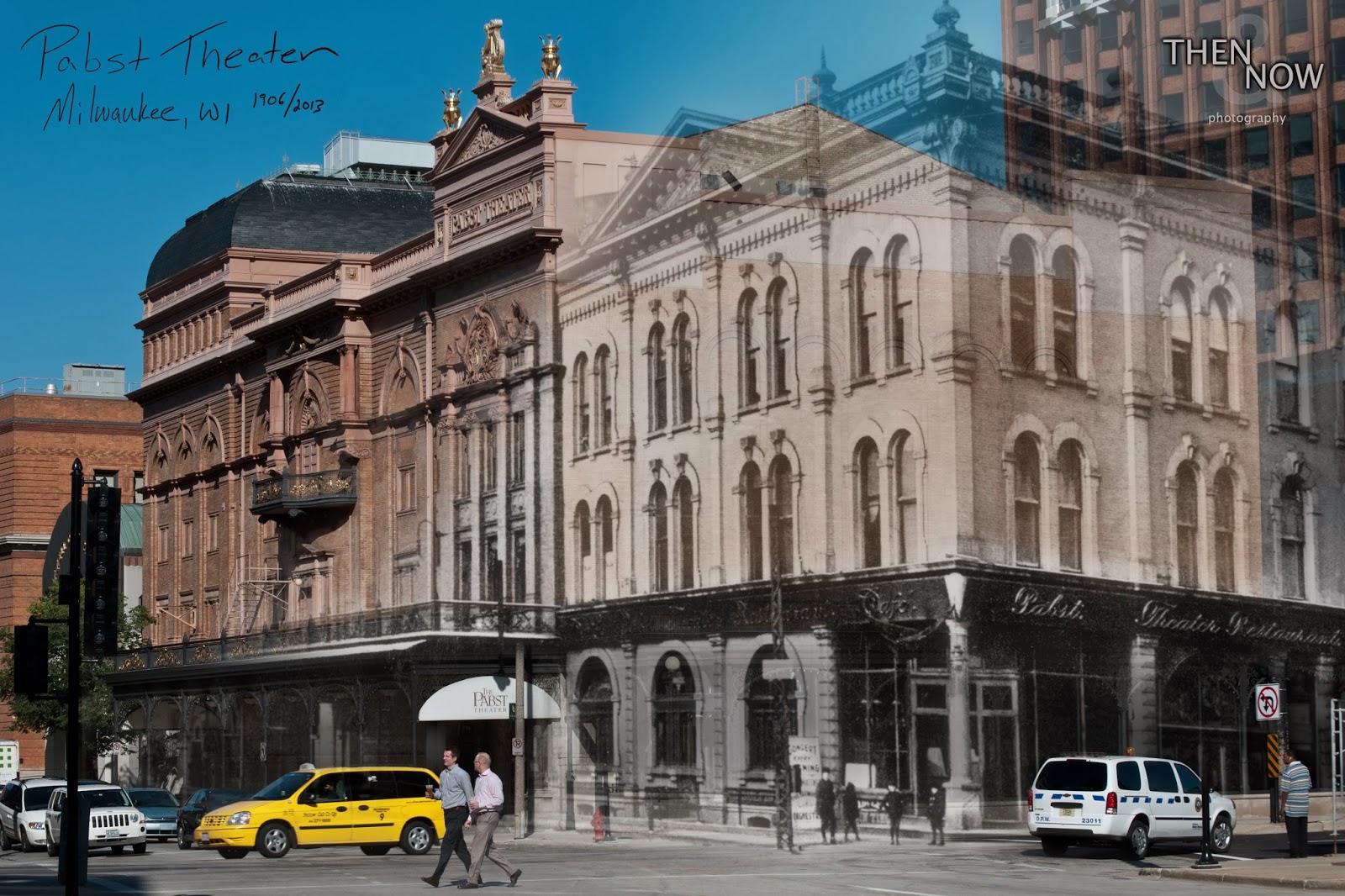
Then & Now: Milwaukee, WI - The Pabst Theater


Then & Now: Milwaukee, WI - The Pabst Theater

Years: 1906 / 2013

View from street of The Pabst Theater and main entrance on corner of Wells and Water Streets.

Sunday, October 27, 2013

"The Camera as a Window into The Past" by Claire Morgan


The Camera as a Window into The Past
Looking at a photo that blends a modern scene with a picture taken from exactly the same spot many decades ago is a strange experience. When we see these two scenes entangled with one another, we experience first hand two of the most powerful effects of photography: its ability to trigger our own memories and its capacity to record history. We feel as if we are looking back through a window into the past, but we are still tied to the modern world in such a way that history begins to feels alive and very personal. These images prove to us how much photography matters.
Why Taking Photographs Matters
The way in which we see the past and remember our own lives is shaped by photography. Photos matter because they allow us to see important historic moments for ourselves, in a manner that cannot be matched by any historical document or portrait, but they are also important because they provide a means to record and share our own memories. Many of us take our own photos on vacation, to mark special occasions, or simply to capture moments in our everyday lives, but we may not stop to think about why these photos matter so much or why it is so important to use and look after our photographic equipment and preserve our pictures for future generations. The photos we take now will shape the stories and memories we share in the future, as well as providing people in the distant future with the chance to look back through a photographic window into our times.
Photography and Memory
Although photographs are an important part of our understanding of history, their significance does not end with great events and famous figures. Photography can preserve our own family histories and memories, enabling us to recall and share the most important stories of our lives. The photographs we take in our own lives can shape the way we remember events. Many of the memories we have from childhood are influenced by the photographs we have kept, and the stories that people have told around those images. When we recall the past or ask our parents and grandparents about their lives, it is often over an album of photos. The effect can be so strong that it is even possible to make people believe in false memories by showing them faked photographs of a supposed childhood trip in a hot air balloon.
Photography and the Past
Photographs can also provide us with a window on worlds that we cannot experience for ourselves, including those that have disappeared into the past. Photos have become such an important part of the historic record that they make the time before cameras were invented feel far more distant and mysterious to us than the years that we can look back at in photographs. The difference is clear when we see some of the earliest photos of US Presidents and compare the experience to viewing the portraits that are the only surviving images of others. Seeing the real faces of our ancestors, or of important historic figures, can be far more powerful that any portrait or written description. We feel that we are stepping back into the shoes of the photographer who recorded the scene, and seeing the world through their eyes.
Photographs of Then and Now
Photographs have power over our memories and our perceptions of the past, but it is when these two aspects of photography collide that something truly special is created. The effect of images that combine pictures of the same scene then and now stems from the combination of the chance to look back into the past with the emotional resonance of modern photographs that can evoke our own personal memories. When we come across historical photographs in textbooks or museums, their power can be limited by the fact that we view them in a somewhat dry and distanced way. Combining these photographs with modern images taken in the exact same spot awakens the more personal and emotional part of our reaction to photography, by bringing these scenes of the past into direct contact with our modern lives. The effect is strongest when we know the location ourselves, since our own memories of the location will be awakened by the modern picture, heightening our reaction to the historic scene, but even in an unfamiliar place, the effect is striking. Seeing the old and new coexisting alongside one another brings the past alive and enables us to appreciate just how close we are to the black and white faces that we see in the photographs. To see them walking the streets alongside the familiar bustle of modern life is to see them as real people.

By: Claire Morgan

Friday, October 25, 2013

Then & Now: Milwaukee - Solomon Juneau Monument


Then & Now: Milwaukee - Solomon Juneau Monument 

Years: 1940 / 2013

Monument (erected 1887) dedicated to Solomon Juneau at Juneau Park. A an sits on the bench with Lake Michigan behind. 


Brief History:

Solomon Juneau...

Fur Trader. 

Land Speculator. 

Politician.  

"The Founder of Milwaukee"...   

His cousin - Joseph Juneau - also founded the city of Juneau, Alaska!

To read more about this fantastic man - check out this link or one many other articles you can find on google..  http://en.wikipedia.org/wiki/Solomon_Juneau

Then & Now: Milwaukee - Civil War Monument


Then & Now: Milwaukee - Civil War Monument 

Years: 1920's / 2013 
The Court of Honor, Wisconsin Avenue. The statue, "The Victorious Charge," is in the center, with new traffic on the right. On the left are more buildings going into the distance, with cars and park area. On the statue is inscribed "To Those Who Fought In The War For The Union 1861-1865. Erected 1898."

 Original Photograph by: Murdoch Photographers


Then & Now: Milwaukee - "Muddy Street"


 Then & Now: Milwaukee - "Muddy Street"
Years: 1901/2013


A man tips his hat to a passing woman as horse-drawn carts and pedestrians navigate through the dirt and mud of Milwaukee streets, thereby illustrating that the problem of impassable streets had not been solved, even in Wisconsin's largest city, at the turn of the 20th century.

SE corner of E. Wisconsin Ave. at N. Milwaukee St. facing west. The Wells Building is on the right, 1 block west at SW corner of Wisconsin Ave. and N. Broadway on the left is the Railway Exchange Buildingg, the Pabst Building (NE corner of N. Water St. and E. Wisconsin Ave.) is the tower in the distance on the right (no longer there). In the distant center of the photo is the former Gimbels Department Store block on the east side of the Milwaukee River. (Using post-1930 street names.)

Original Photograph by: Robert J Taylor


Then & Now: Milwaukee - Michigan Street Bridge


Then & Now: Milwaukee - Michigan Street Bridge

Seen in the foreground you can see several men at work, constructing the Michigan Street Bridge that crosses the Milwaukee River from the east bank to the west bank.  In the background you can see a number of bypass walkways and bridges that have since been constructed.  

Years: 1905 / 2013

Original Photographer: Robert J. Taylor 

Then & Now: Milwaukee - Wisconsin Avenue Bridge


Then & Now: Milwaukee - Wisconsin Avenue Bridge
Years: 1928/2013
An open drawbridge with a boat crossing below. The First National Bank is in the background.  

Original Photograph by: Murdoch Photographers